Best and Worst Kia Sedona Years to Avoid: A Complete Guide
When considering purchasing a Kia Sedona, consider whether to use it for family trips or for your day-to-day tasks. it is prudent to understand which model years to avoid and which ones are the best investments. The Kia Sedona is a reasonably well-known minivan that has been on the market for over 20 years.
And this has been due to its practicality and comfort. However, it was not any different with the car model, as there were years that were more problematic than others.
We will be deconstructing all you should know in this guide on Kia Sedona years to avoid the most frequent problems, as well as the most secure and reliable model years. We will also share with you the real owner’s experiences and recollections of information, so that you can make the best choice when purchasing your next minivan.
Why Knowing Kia Sedona Years to Avoid Matters
The Kia Sedona enjoys a good image as a dependable and family-friendly car. Nonetheless, not every model year is produced equally. Others in Sedonas had grave problems like engine stalling issues, electrical problems, or safety issues, which resulted in recalls.
Purchasing a model year that is not correct may result in significant repair costs or even cause fatalities. However, when it comes to selecting the appropriate year, you will also have a reliable ride with fewer or no headaches.
This is why the Kia Sedona models remaining off is one that many buyers ask before committing. Now, we will examine the issues that are most likely to occur and which years to avoid in particular.
Popular Issues in Kia Sedona Models
Although the Kia Sedona is a reasonably reliable car, several common issues have been encountered throughout the years:
1. Stalling and Power Loss of the Engine.
Specifically, older models of Sedonas tended to stall the engine or lose power unexpectedly. It was usually caused by a faulty crankshaft position sensor, which informs the engine when to fire. Failure of this sensor may cause the engine to jerk, lose power, or even stall.
This sensor misreading was causing rough idling or strange startups for drivers. The good news? The solution to these problems is, in most cases, replacing the sensor without incurring expensive engine repairs.
2. Problems of Transmission Shifts.
There have been some years with issues related to the automatic transmission lever or shift linkage. In other incidents, the shift lever may end up out of park, exposing the vehicle to the risk of rolling away on its own. This was a critical security issue, resulting in recalls to install remedies.
3. Electrical and Wiring Problems.
There have been headaches in several Sedona years due to electrical faults. Issues were also such as faulty alternators, faulty wiring under the seats (which posed risks of fire), and frozen A/C compressors. Loose connections with battery terminals also caused recalls.
4. Paint and Rust Concerns
Although not hazardous, some Sedonas, particularly in the years 2005 and 2006, had peeling paint and rust on the edges of the hood or doors. This may influence the vehicle’s appearance and resale value, but did not affect its driving performance.
The Worst Kia Sedona Years to Avoid
According to owner complaints, safety reports, and recall history, the following are the poorest Kia Sedona years to avoid if you wish to avoid paying too much in terms of repairs and safety concerns:
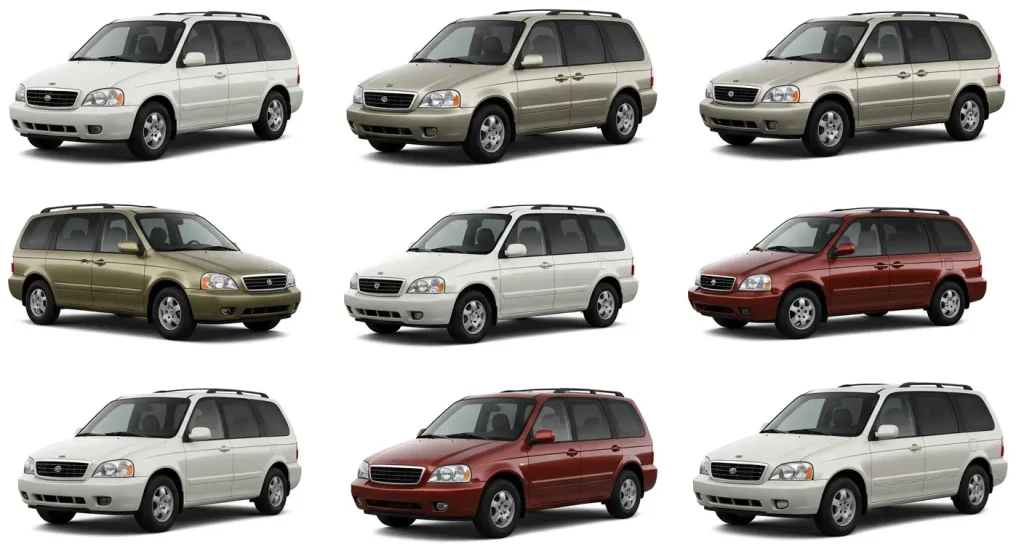
2002 and 2003: Early first-generation Sedonas that had engine sensor faults and fire risk. Spare parts can be costly for older models.
2005/2006: It has a reputation for paint problems, rust, and wiring that is hazardous, leading to fires under the driver’s seat, and a faulty seatbelt assembly that is also affecting safety.
2012: Bad safety scores and electrical issues that recalls have since handled.
2015, 2016: Electrical problems, a malfunctioning transmission shifter that has a rollaway risk, and headlights that might be a danger to driving safety.
2020: The first year of the fourth-generation Sedona was associated with battery corrosion and wiring issues, which resulted in recalls.
These years were not so reliable or safe, as each of them had specific flaws. By avoiding them, it is possible to reduce the risks of unexpected repairs and have greater peace of mind.
Best Kia Sedona Years to Buy
In case you would like to have a Kia Sedona that will not have many issues, you should pay attention to the following recommended years:
1998-2001: First models of solid reliability.
2004, 2007-2011:The Second generation has been well built with fewer problems
2013-2015: Clean third-generation start, with a few issues in 2015.
2017-2019: Better third-generation models with remedies to the previous defects.
2021-2022: The latest, modern, and reliable recalls have been resolved.
These model years offer more safety ratings, reduced recalls and satisfied owners. For example, the 2017 Kia Sedona has a high rating for smooth riding and better electrical systems compared to the model that has problems, namely, the 2016 model.
Dividing It Generation by Generation
Then let us have a closer look at problematic years in each Sedona generation:
First Generation (1998-2005)
Best: 1998-2001 (a few issues reported)
Avoid: 2002-2003 (engine, fire hazards)
The earliest models manufactured post 2001 started showing sensor and engine problems, and there was a possibility of fire outbreak by faulty wiring.
Second Generation (2006-2S013)
Best: 2007-2011 (generally solid years)
Avoid: 5-2006 (rust, paint, wiring, seatbelts), 2012 (poor safety)
The second-generation Sedonas proved to be reliable, except that the 2005-2006 and 2012 models elicited more complaints.
Third Generation (2014-2019)
Best: 2017-2019 (addressed most of the previous problems)
Avoid: 2015-2016 (electrical, transmission, lighting problems)
The 2016 model, specifically, was prone to recalls caused by faults in wiring and safety system.
Fourth Generation (2020 and later)
Best: 2021 onwards
Avoid: 2020 (electrical fault and battery terminal fault)
There were specific growing pains in the 2020 launch that were mostly rectified several years later.
Actual Owner Experiences and Maintenance Information
People who own Kia Sedonas tend to have positive remarks about its spacious cabins and comfortable rides. Nevertheless, buyers of problematic years frequently complained about issues with power loss, rough idling, or electrical problems.
With an existing Sedona, some general issues can be prevented with routine maintenance:
Install crankshaft position sensors immediately when they start showing difficulties.
Pay attention to warning lights connected with the engine or transmission.
Check under-seat wiring for wear or damage.
Clean and lock battery terminals.
Carry out any recall repairs promptly.
Numerous owners report that their Sedonas have travelled much more than 150,000 miles with the appropriate maintenance.
Safety Ratings and Recalls
The safety of Kia Sedona has been increasing with every generation. Older models performed poorly in their crash test, although newer Sedonas scored well on the National Highway Traffic Safety Administration (NHTSA) and the Insurance Institute of Highway Safety (IIHS).
Recalls have been required in the repair of:
Defective wiring poses fire risks.
Rollaway risk Transmission shift lever Transmission shift lever rollaway risk.
Electrical failures are often caused by battery terminal corrosion.
Seatbelt restraint issues
Ensure that the Kia Sedona you are considering purchasing has had all its recalls addressed. This would protect you from costly repairs in the future.
Alternatives to Consider
Should you be in the market to purchase a minivan and you do not want the Kia Sedona, then you should consider the following:
Honda Odyssey: The Honda Odyssey is a reliable family car.
The Toyota Sienna features all-wheel drive and boasts a high safety rating.
Chrysler Pacifica: Contemporary style and technology, but split reviews.
Dodge Grand Caravan: cheaper and older design, but with fewer safety measures.
They both have advantages and disadvantages. Although the Kia Sedona is not without its value and comfort, it is recommended that you ensure you have the correct model year.
Final Words- Kia Sedona Years to avoid.
The Kia Sedona is a nice option that offers a viable and comfortable minivan to buyers. The years to be careful of in Kia Sedona should be on top of your list of research.
Avoid these years: 2002, 2003, 2005, 2006, 2012, 2015, 2016, and 2020.
The most profitable years to purchase are 1998-2001, 2004, 2007-2011, 2017-2019, and 2021 and beyond.
You will have a pleasant ride and will not be surprised by any problems, as you’ve avoided these issues for years and the recall repair.
The Kia Sedona is also worth considering if you want a hassle-free family van, although you should make a wise choice. Have you been using a Kia Sedona of any year? What was your take? Feel free to share!
FAQs
The best course of action is to avoid the 2002, 2003, 2005, 2006, and 2012 Sedona models. The 2016 version was also facing specific electrical issues that the owners reported.
Some of these problems include inadequate electrical wiring harnesses, risks of fire through the wires below the seats, and issues with the alternator, as well as crankshaft position sensor failures that may lead to an abrupt loss of power.
Yes, the Sedona is usually a good bet, although not during the above-named problematic years.
Specific 2016 Sedona models experienced issues with the automatic transmission shift lever, which tended to slip out of position, potentially allowing the vehicle to roll away.
For more smart guides about vehicles, you must read the guides below: